In the last 6 months, we at Sol Realty have rejected 40% of the listings offered to us.
Why? Because in Goa, a “For Sale” board doesn’t always mean the seller has the right to sell. From “double-sale” scams to the complexities of the Portuguese Civil Code, the Goan market is a minefield for the uninitiated investor.
We believe in Radical Transparency. We don’t just want to sell you a home; we want to ensure you actually own it. Here is the exact Due Diligence Protocol we use—and that you should demand from any agent.
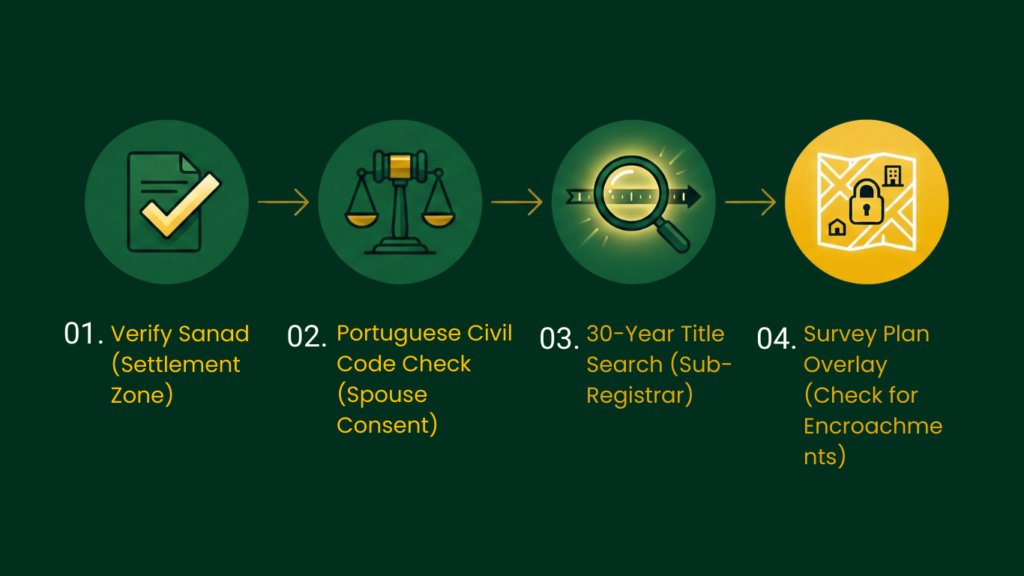
1. The “Sanad” Trap: Agricultural vs. Settlement
The Scam: A broker shows you a stunning “farmhouse” plot in a green zone. It’s cheap. He says, “Don’t worry, we will get the conversion done later.” The Reality: If you are not a farmer in Goa, you generally cannot buy agricultural land. Furthermore, structures built on Orchard/Agricultural land without a Conversion Sanad are illegal and prone to demolition.
The Sol Check: We demand the Sanad (Conversion Certificate) upfront. It must explicitly state the land use is for “Settlement” or “Commercial” purposes. No Sanad, No Deal.
2. The Portuguese Civil Code: The “Spouse” Clause
The Law: Under Goa’s unique Portuguese Civil Code (1867), ownership is often jointly held by both spouses, regardless of whose name is on the deed.The Risk: You buy a property from Mr. X. He signs the deed. Six months later, Mrs. X sues you, claiming she never consented to the sale. The court will void your sale. The Sol Check: We require the signature and consent of both spouses for every transaction. If it’s an inherited property, we conduct a “Family Tree Verification” to ensure no long-lost cousin has a claim.
The Sol Realty Check
3. The NRI/OCI Landmine (FEMA Rules)
The Myth: “I have an OCI card, I can buy anything.” The Reality: Under FEMA (Foreign Exchange Management Act), NRIs and OCIs cannot purchase agricultural land, plantation property, or farmhouses in India.The Sol Check: We strictly filter listings for our NRI clients to ensure they are acquiring non-agricultural, residential-zoned assets to prevent future litigation from the Enforcement Directorate.
4. The “Paper Road” & CRZ Violations
The Risk:
Paper Roads: The survey plan shows a 10-meter access road. In reality, that road doesn’t exist, or it runs through a neighbor’s private property.
CRZ (Coastal Regulation Zone): That sea-view villa? If it’s within 200m-500m of the High Tide Line and lacks specific CRZ clearance, it is illegal.
The Sol Check:
We physically measure the access road.
We overlay the property coordinates with the CZMP (Coastal Zone Management Plan) maps to ensure it is outside the No-Development Zone.
5. Why “RERA Registered” is Your Safety Net
In a market of fly-by-night developers, RERA (Real Estate Regulatory Authority) is your only shield. It mandates that developers deposit 70% of your money into a separate escrow account, used only for construction, not for buying their next Ferrari.
The Sol Promise: We do not list under-construction projects that lack a valid Goa RERA number. Period.
Conclusion: Trust, but Verify
Buying luxury real estate in Goa is an emotional journey, but the transaction must be purely logical. At Sol Realty, we bring the rigorous professionalism of the Pune market to the susegad coast. We act as your risk mitigators first, and your brokers second.